
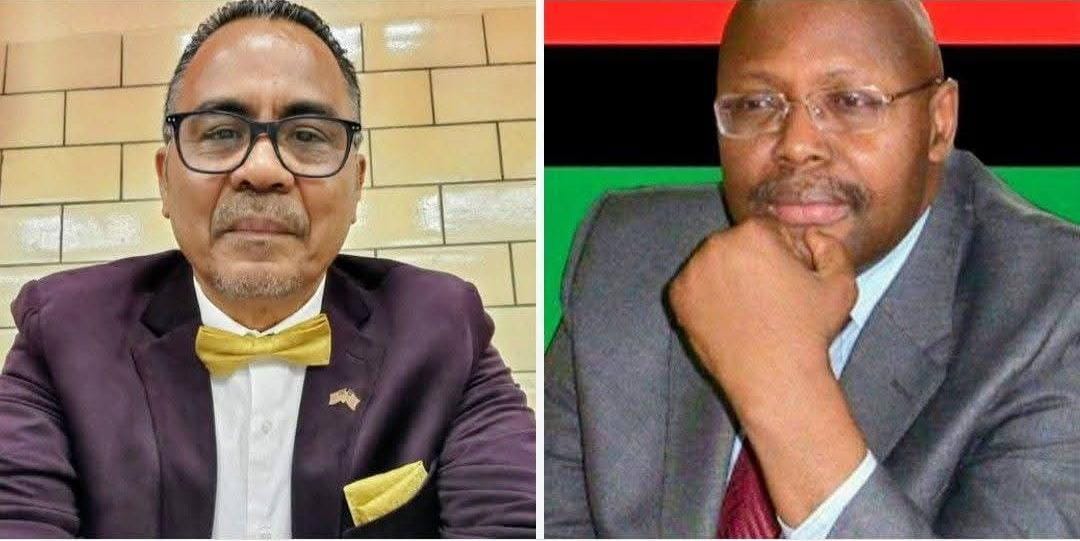
What Dr. H. Boima Fahnbulleh’s Replies Actually Reveal
By: Ian Yhap, August 3, 2026
Before this discussion becomes buried beneath insults, accusations, revolutionary vocabulary, family histories, and arguments over who knows whom, it is useful to return to the beginning. This entire exchange began with a statement by Miatta Fahnbulleh concerning Charles Taylor: “I can never say anything nice about Charles Taylor. I hold him responsible for the destruction of three generations of Liberians.” Michael T. Biddle responded by arguing that, although Charles Taylor bears enormous responsibility for Liberia’s destruction, the history of armed resistance and revolutionary organization did not begin with him. Michael identified Dr. Henry Boima Fahnbulleh, Jr. as one of the political actors whose activities preceded Taylor and contributed to the environment from which later armed movements emerged. I shared Michael’s post and added my own commentary. My central point was straightforward: Miatta Fahnbulleh had every right to express her opinion about Charles Taylor. No one had attempted to silence her. But free speech is a two-way street. If she had the right to identify Taylor’s role in Liberia’s destruction, others had an equal right to examine the actions of other political actors whose activities preceded Taylor’s rebellion. I did not accuse Miatta of responsibility for her brother’s conduct. I expressly stated that she bore no responsibility for his decisions. I did not claim that Dr. Fahnbulleh personally ordered killings, mutilations, massacres, or atrocities during the civil war.
My argument was historical rather than criminal. I argued that Liberia’s descent into war did not begin on December 24, 1989, when Charles Taylor’s forces entered Nimba County. Before Taylor crossed the border, other Liberians had already embraced the idea that organized force, revolutionary preparation, military training, and armed resistance were legitimate methods of removing a government. I wrote: “One could even argue that the actions of Henry Boima Fahnbulleh, Jr. and others in the early 1980s helped create the very conditions that made Charles Taylor’s emergence possible. By recruiting, organizing, and facilitating the training of young Liberians for armed insurrection, they introduced a model of violent political change that Taylor would later inherit, expand, and ultimately dominate. In that sense, Taylor did not invent the path to civil war. He walked through a door that had already been opened.” That was the argument. It did not absolve Charles Taylor, it did not transfer Taylor’s crimes to Dr. Fahnbulleh, it did not accuse Dr. Fahnbulleh of commanding Taylor’s NPFL, and, it did not claim that he ordered atrocities. It asked a question of historical causation: Who helped create the political culture, revolutionary networks, military relationships, and belief in armed political change that existed before Taylor’s invasion? Dr. Fahnbulleh responded with an article titled Where Ignorance Is Bliss, ’Tis Folly to Be Wise! He later followed it with a shorter piece titled Dancing on the Edge. Both replies are caustic. He calls me a “political neophyte,” a “weakling,” a “historical falsifier,” a “disgruntled historical reject,” and a man with a supposedly limited attention span. He suggests that my views are products of inherited agony because my mother was related to President William R. Tolbert. Those personal attacks may entertain some readers, but they do not resolve the historical question.
In fact, when we remove the insults and examine what Dr. Fahnbulleh actually says, something unexpected occurs. He rejects my interpretation, but then supplies facts that support significant portions of the historical framework I presented in his own writing. He complains that I accused him of certain activities, but in the process of defending himself, he acknowledges military training, revolutionary cadres, personal contact with Charles Taylor, intervention on Taylor’s behalf, relationships with foreign security officials, and the presence of militarily trained men around him. These are not facts supplied by Michael Biddle. They are not rumors supplied by “one Yhap.” They come from Dr. Fahnbulleh himself. From this very thread of exchange.
What Did I Actually Accuse Dr. Fahnbulleh Of? Before examining his admissions, we must separate what I actually said from what Dr. Fahnbulleh says I accused him of saying. Throughout his response, he appears to answer several accusations that I never made. He writes: “Yhap cannot show one instance where Fahnbulleh gave any order to shoot, execute, or mutilate anyone during the entire period of Liberia’s civil crisis.” That is true. I cannot show such an order. But I never claimed that I could. I never accused him of personally ordering anyone to be shot, executed, or mutilated. I did not describe him as a battlefield commander. I did not accuse him of being responsible for NPFL atrocities. I did not say that he commanded the RUF or participated in Sierra Leone’s war. Those are arguments he introduces by himself and then defeats. This is a classic substitution of claims. My claim concerned historical influence and political preparation. His answer concerns direct criminal orders. Those are not the same thing. A person can contribute to the development of a political method without personally carrying out every later crime committed by those who adopt or expand that method. An intellectual architect is not necessarily a battlefield commander. A recruiter is not necessarily an executioner. A political organizer is not necessarily responsible for every atrocity committed by a later movement. But the absence of a direct order to kill does not make the earlier political and military organization historically irrelevant. Dr. Fahnbulleh also insists: “One thing I did not do was to unleash on a people a devastating civil war and then to hold them as captives until I was given power.” Again, I did not say that he did. Charles Taylor launched the NPFL invasion. Charles Taylor led the movement that captured territory, was said to have committed widespread atrocities, and brought Liberia into prolonged war. Nothing in my original commentary reduced Taylor’s responsibility. The question is not whether Dr. Fahnbulleh and Charles Taylor were identical. They were not. The question is whether political actors before Taylor had already organized around the idea of armed resistance, military training, revolutionary overthrow, and the removal of the Doe government by force. On that question, Dr. Fahnbulleh’s own narrative is remarkably revealing.
The Scholarship Dispute One of the central disputes concerns the Ministry of Education scholarship program. I referred to contemporaneous reports alleging that some young Liberians sent abroad under educational arrangements later received military or guerrilla training. I also referred to my late friend Matthias Nimley, who told me that he had been among the scholarship recipients. Dr. Fahnbulleh accused me of lying on a dead man. He wrote: “There were no scholarships from Libya and students were never sent to Libya for studies or military training.” That sounds, at first, like a complete denial. But his explanation that follows is far more complicated. He says that during a visit to Ethiopia, he became interested in the Ethiopian adult literacy program. He then secured scholarships for young Liberians to study adult literacy there. He states that Matthias Nimley participated in that program. Then comes the important sentence: “A handful of the brothers, not more than a dozen, stayed behind for basic military training.” That statement changes the discussion. The dispute is no longer whether Liberians sent abroad through a Ministry of Education initiative received military training. Dr. Fahnbulleh acknowledges that some did. His correction is more specific: they were sent to Ethiopia for adult literacy training rather than Libya, and a group later remained for basic military training. That is a meaningful correction, and it should be recorded accurately. If Matthias Nimley attended the Ethiopian literacy program and did not participate in military training, then that distinction also deserves to be acknowledged. Historical discussion must be precise enough to correct errors when new firsthand information is supplied. But the correction does not erase the larger historical issue. Young Liberians went abroad through an educational program initiated under Dr. Fahnbulleh’s leadership.
According to his own account, some of them remained for military training. That is no longer an allegation. It is his testimony. The relevant questions now become: Who were those men? Who selected them for the Ethiopian program? Who decided that they would remain for military training, and under whose authority was that decision made? What was the intended purpose of their training? To whom were they politically loyal, and what became of them after they completed or abandoned the literacy program? The closure of the Libyan People’s Bureau in Monrovia does not, by itself, answer those questions. It only establishes that official relations between Liberia and Libya had been disrupted. It does not mean that Libya ceased its revolutionary activities elsewhere in Africa, nor does it establish that Ethiopia had severed its own cooperation with Libya. On the contrary, Ethiopia and Libya were moving toward a substantial political and military partnership during this same period, later formalized through the August 1981 tripartite alliance involving Ethiopia, Libya, and South Yemen. That relationship is important. It does not prove that the Liberians who remained in Ethiopia for military training were sent onward to Libya. No such conclusion should be asserted without evidence. But neither can the Ethiopian and Libyan channels be treated as entirely unrelated simply because Libya’s diplomatic mission in Monrovia had been closed. Governments do not require an embassy in a recruit’s home country to cooperate with one another, exchange personnel, support revolutionary movements, or facilitate military training through third countries. The questions must therefore continue. Were the men who received military training in Ethiopia later connected to Liberian opposition organizations? Did any of them subsequently travel to Libya or join cadres trained there? Was the Ethiopian program entirely separate from the later Libyan training that Dr. Fahnbulleh acknowledges, or did personnel, organizers, political objectives, or revolutionary networks overlap? What exactly did Dr. Fahnbulleh mean when he wrote that “whatever training took place under my watch occurred in 1989”? Which men were trained, where were they trained, who arranged it, and for what purpose? These questions do not manufacture guilt. They seek to establish continuity, if continuity existed, between the early Ethiopian training, the later training of cadres in Libya, and the broader organization of armed opposition to the Doe government. Dr. Fahnbulleh’s correction may require us to distinguish between the Ministry of Education program in Ethiopia and later revolutionary training in Libya. But distinguishing the two programs is not the same as demonstrating that they were politically or organizationally unconnected. The closure of an embassy is a diplomatic event. It is not a wall erected across the African continent. It did not prevent Ethiopia and Libya from cooperating, and it does not eliminate the need to investigate whether the Liberian participants, political organizers, or revolutionary objectives associated with the two training streams ever converged. These are legitimate historical questions. Calling the person who asks them a liar does not answer them.
Libya and the Cadres
Dr. Fahnbulleh strongly objects to the suggestion that Ministry of Education scholarships were used to send young Liberians to Libya. Yet later in the same discussion he writes: “As for training in Libya of cadres, this had nothing to do with the Ministry of Education.” This sentence is important because it does not deny the training of cadres in Libya. It separates that training from the Ministry of Education program. That distinction may be entirely correct, but it confirms that there was, in fact, another stream of military or revolutionary preparation involving Libya. He then adds: “I left the military government in 1983 and whatever training took place under my watch occurred in 1989.” The wording is curious. Whatever training took place “under my watch” occurred in 1989. What training? Whose training? Who were the cadres? Where did it take place? Who arranged it? What political objective did it serve? What does “under my watch” mean in this context? Was the training merely protective, or was it connected to a plan to overthrow the Doe government? These questions arise not from Michael Biddle’s post or from my commentary, but from Dr. Fahnbulleh’s own language in his response. He appears to deny one specific channel, Ministry of Education scholarships to Libya, while acknowledging the broader reality of trained cadres and military preparation. This is why I say that his response narrows the argument but does not destroy it. The original allegation may have merged two separate processes: an educational program in Ethiopia, where some men remained for military training, and a later revolutionary training program involving Libya. If so, the historical record should be corrected to distinguish those processes. But distinguishing them does not make either disappear. “I Played No Part in the Civil War” Dr. Fahnbulleh writes: “As a matter of fact, I played no part in the civil war but had brothers around me who were trained in military matters in order to protect me.” The first part of the sentence is a categorical denial. The second part introduces complexity. He says that militarily trained men surrounded him for protection. Again, this does not establish that he commanded a faction in the civil war. It does not prove that those men committed atrocities. It does not make him criminally responsible for their actions. But it establishes that he existed within a political environment in which trained armed personnel formed part of his security structure.
That fact belongs in the historical record. We should also ask what period he is describing. Were these men around him before the war, during the war, or after the war began? Where had they been trained? Under whose authority did they operate? What organization did they belong to? What threats were they guarding him against? Dr. Fahnbulleh may have entirely reasonable answers. But the questions cannot be dismissed simply because he characterizes the men as “brothers” protecting him. The language of brotherhood is politically warm, but it does not erase military organization.
The Charles Taylor Relationship Perhaps the most striking section of Dr. Fahnbulleh’s article concerns Charles Taylor. My argument was that Taylor did not emerge from a political vacuum. He entered a world in which exiled Liberians, revolutionary organizers, foreign governments, security services, and armed opposition networks were already operating. Dr. Fahnbulleh rejects the suggestion that Taylor inherited a path created by him and others. Yet he supplies an extraordinary account of his own relationship with Taylor.
He writes: “Charles Taylor was invited to Ghana by me as I had some friends in security.” He explains that his purpose was to prevent Samuel Doe’s government from capturing and killing Taylor. That concern may have been genuine. Exiles often protect one another from hostile regimes, and offering asylum or protection does not make a person responsible for what the protected individual later does. But the relationship is historically significant. Dr. Fahnbulleh says that Taylor contacted him after escaping from detention in the United States. According to his account, Taylor wanted to know what had happened in November 1985 and what was being done to remove Doe’s military government. That is not a casual social conversation. It places Taylor and Fahnbulleh within the same anti-Doe political universe. Dr. Fahnbulleh then says that he helped arrange Taylor’s presence in Ghana through contacts in Ghanaian intelligence. When Taylor was arrested, Dr. Fahnbulleh intervened.
He writes: “I contacted my senior security friends in the intelligence services and told them that Charles Taylor was the man I told them about who wanted asylum in Ghana like many of us.” He later states: “I managed to get Charles Taylor released and left Ghana thereafter.” These are substantial admissions of political association and assistance. Again, they do not make Dr. Fahnbulleh responsible for Taylor’s later crimes. At that point, Taylor had not yet launched the NPFL invasion. Dr. Fahnbulleh may have believed he was protecting a fellow Liberian exile from execution or unlawful rendition. But history must account for consequences as well as intentions. Taylor’s survival, movement, contacts, and access to regional networks were essential parts of the path that later took him to Burkina Faso, Libya, and ultimately the Liberian border. Dr. Fahnbulleh tells us that he helped Taylor at a critical moment in that journey. He then describes Taylor’s second arrest in Ghana and the circumstances that eventually led to Taylor’s transfer to Burkina Faso. According to his narrative, not mine, Taylor’s mistress contacted the Burkina Faso Embassy. Blaise Compaore’s associate then intervened, Taylor was released, flown to Ouagadougou, and eventually taken to Tripoli.
Then Dr. Fahnbulleh asks: “What has this got to do with Fahnbulleh?” The answer is not that he planned Taylor’s invasion. The answer is not that he controlled Burkina Faso or Libya. The answer is not that he knew every future action Taylor would take. The answer is that his own story places him inside the political network through which Taylor moved during the years before the invasion. That has something to do with Dr. Fahnbulleh because he himself has told us that it does. He invited Taylor to Ghana. He used his security contacts to support Taylor’s presence there. He intervened to secure Taylor’s release. He knew of Taylor’s interest in removing Doe. He knew of the regional networks surrounding Liberian exiles and revolutionaries.
Those facts do not prove criminal responsibility. They do, however, establish historical proximity and political involvement.
Did Taylor Walk Through an Already Open Door? Dr. Fahnbulleh treats my “open door” language as a childish attempt to portray Charles Taylor as a helpless follower. That is not what the metaphor means. To say that a door was already open does not mean Taylor lacked agency. Taylor chose to walk through it. He then widened it, destroyed its hinges, and drove an army through the opening. He remains responsible for those decisions. But before Taylor, the idea of removing the government by force had already been discussed, organized, and pursued by multiple Liberian political actors. Dr. Fahnbulleh’s own reply confirms several elements of that pre-Taylor landscape: There were Liberians sent abroad who received basic military training. There were cadres associated with later training in Libya. There were organized anti-Doe exiles. There were relationships with foreign intelligence and security services. There were contacts with revolutionary governments and regional political actors. There were trained men attached to political figures. There was communication with Charles Taylor concerning the removal of the Doe government. There was intervention to protect Taylor and keep him within the exile network. This is the political infrastructure I was describing. Taylor did not invent exile politics. He did not invent revolutionary training. He did not invent the use of foreign governments and intelligence relationships. He did not invent the idea of removing Doe by force. He was, however, the man who consolidated these elements into the most destructive armed movement in Liberia’s history.
The Argument About 1979
Dr. Fahnbulleh argues that the political violence that shaped Charles Taylor was not created by him or other revolutionaries. He locates the decisive moment in the violence of April 1979. He writes that the Tolbert government’s response to the Rice Riots demonstrated the political power of violence and taught Taylor a lesson. The events of April 1979 unquestionably belong in any serious account of Liberia’s descent into instability. People were killed. Political tensions deepened. Public confidence collapsed. The state’s response helped widen the distance between the government and large sections of the population. Those events should not and must not be sanitized. But recognizing 1979 does not erase what came afterward. Political causation is not a single straight line. History is less a solitary gunshot than a chain of sparks moving through dry grass (use a simpler metaphor) Liberian patois “when you pull rope, rope will pull bush”. The violence of 1979 may have contributed to the conditions for the 1980 coup. The 1980 coup produced executions, military rule, repression, ethnic tensions, and institutional collapse. The repression and failures of the Doe government produced exile movements and revolutionary opposition. Those movements established contacts, recruited supporters, and pursued military training. The failed 1985 invasion and the reprisals that followed intensified grievances, particularly in Nimba County. Charles Taylor later exploited those grievances, networks, divisions, and foreign relationships. Each stage influenced the next. There is therefore no need to choose between 1979 and the activities of anti-Doe revolutionaries. Both belong in the story. Dr. Fahnbulleh seems to argue that because political violence existed before his activities, his own actions cannot be considered part of the chain. That does not follow. The fact that a door was first cracked open by one group does not mean others played no role in widening it. Responsibility in history is not transferable, but influence is cumulative.
Family, Class, and the “Graveyard of Agony”
Dr. Fahnbulleh also attempts to interpret my argument through my family background. He writes that when he first saw me, he noticed a “hostile sneer.” He says that after being told I was related to the Tolbert family, he understood my supposed hostility as the expression of someone “living in the graveyard of his agony.” That passage reveals more about his method than it does about my facial expression. Before knowing me, he interpreted my face. After learning my ancestry, he interpreted my motives. My argument was no longer treated as an argument. It became an inherited grievance. This is convenient because it allows him to avoid confronting what I said on its merits. If my questions can be reduced to family bitterness, then he need not answer them historically. Again, it is true that my mother was a niece of President Tolbert. I did not select my mother. I did not select my extended family. I did not choose the circumstances of my birth. No person should be praised or condemned merely because of the family into which he was born. Dr. Fahnbulleh later insists that he does not care into which family a person was born. Yet in his first article, my family relationship becomes the key through which he explains my expression, political outlook, and supposed hostility. There is a juxtaposition there, but more importantly, from the comments on the posts, the old class narrative has lost much of its explanatory power in present-day Liberia. This I pointed out in my last response. The ordinary Liberian is not living inside a revolutionary textbook. Regardless of ancestry, most Liberians confront broken roads, unreliable electricity, inadequate healthcare, failing schools, unemployment, and declining public institutions. Whether one was born into a so-called settler family, an indigenous family, a political family, a rural family, or an urban family, nearly everyone is catching hell. That is the Liberia successive generations of political leaders have bequeathed to the younger generation. The question today is not merely who belonged to which class in 1979. The question is what political choices were made afterward and what those choices produced. Again, a person cannot choose his ancestry, but, he can choose his politics, he can choose whether to recruit, he can choose whether to organize., he can choose whether to pursue military training, he can choose whether to assist another political actor, and he can choose whether to support armed resistance. Those choices, not birth, are legitimate subjects of historical inquiry.
“I Do Not Know You”
Much energy has also been spent debating whether Dr. Fahnbulleh knows me. He says he does not. Yet he remembers where he encountered me, why I was in the office, what assignment I was performing, what Dr. McClain was discussing, what expression he claims to have seen on my face, and what he later asked others about me. In his second article, he remembers even more. He remembers that I was involved with the Executive Mansion renovation, he remembers seeing me in Dr. McClain’s office, he remembers overhearing the subject of the conversation, he estimates how long he remained in my presence, and, he recalls asking about my identity and family background. This is a remarkable collection of memories concerning someone he does not know. Perhaps we define “know” differently. I never said we were close friends. I specifically said that we were not friends and were not enemies. I described us as professional acquaintances whose paths crossed in government. That remains a fair characterization. But this dispute over familiarity is ultimately less important than the historical record. We need not be friends to discuss Liberia. We need not have shared drinks, nightclubs, bars, or entertainment. His lengthy assurance that he neither drinks nor smokes and does not attend nightclubs has nothing to do with whether our paths crossed professionally. Political seriousness is not measured by abstinence from entertainment, nor does a person become historically correct merely because he does not drink.
Dancing on Which Edge?
Dr. Fahnbulleh titled his second response Dancing on the Edge. The phrase appears only near the end: “Come prepared, because at the moment, you are dancing on the edge.” The edge is never defined. Is it the edge of historical inquiry? The edge of acceptable disagreement? The edge of his patience? The edge of established political narratives? The edge between questions that may be asked and questions that are forbidden? If asking how revolutionary movements developed before Charles Taylor constitutes dancing on the edge, then perhaps the edge is precisely where serious inquiry belongs. History is not advanced by remaining safely in the center of inherited narratives. It is advanced by examining the uncomfortable boundaries, the contradictions, the missing documents, the competing memories, and the facts that principal actors reveal while attempting to defend themselves. There is another irony. Dr. Fahnbulleh warns me to listen to his nine-hour testimony before discussing history. Yet in these two written articles, he has already supplied an important historical record. He has told us about the Ethiopian literacy scholarships. He has told us that some recipients remained for military training. He has acknowledged cadres trained in Libya. He has referred to training conducted “under my watch.” He has told us about trained men around him. He has told us that Charles Taylor contacted him. He has told us that he invited Taylor to Ghana. He has told us that he used his Ghanaian security connections on Taylor’s behalf. He has told us that he helped secure Taylor’s release. He has described the network through which Taylor later reached Burkina Faso and Libya. This is valuable testimony. It should not be dismissed. It should be studied. Whew! I did not have to watch the testimony after all. Denial of the Conclusion, Confirmation of the Framework I want to be clear here. Dr. Fahnbulleh has not confessed to launching Liberia’s civil war. He has not confessed to ordering atrocities. He has not accepted responsibility for Charles Taylor’s decisions. He strongly rejects those conclusions. It would therefore be inaccurate and unfair to say that he confessed to crimes I never accused him of committing. But he has done something historically significant. While denying my interpretation, he has confirmed many of the underlying circumstances upon which that interpretation rests. He denies that Ministry of Education scholarships sent students to Libya, but acknowledges an Ethiopian scholarship program from which some men remained for military training. He distances the Ministry from Libya, but acknowledges the training of cadres in Libya. He denies participation in the civil war, but acknowledges surrounding himself with militarily trained men. He denies historical responsibility for Taylor, but acknowledges inviting Taylor to Ghana, communicating with him about the anti-Doe struggle, intervening with Ghanaian intelligence, and securing his release. He denies that earlier revolutionary networks opened a path that Taylor later used, but then describes those very networks in considerable detail. This is not a confession of guilt. It is something more useful to historians: firsthand evidence. Dr. Fahnbulleh may believe these facts vindicate him. Others may believe they implicate him politically. Future generations may reach conclusions different from both of ours. But they will now have his words. That is precisely why these discussions matter.
Coming Out of the Shadows
I have repeatedly encouraged Liberians who played important roles in our history to tell their own stories. Not through supporters. Not through descendants. Not through whispered versions. Not through political mythology. Tell the story yourselves. Explain why decisions were made. Identify the people involved. Name the countries. Describe the training. Explain the relationships. Acknowledge what succeeded. Acknowledge what failed. Acknowledge what was intended. Acknowledge what followed, even when the consequences were not intended. Dr. Fahnbulleh has begun to do that and I have nothing else to add. For that, he should be encouraged. His account contains insults, distractions, and attacks on my character. But beneath the polemics is valuable testimony. The task now is to separate the evidence from the anger. The Apostle Paul wrote in Philippians 1:15–18 that some preached Christ from goodwill and others from envy, rivalry, or selfish ambition. Yet Paul rejoiced because, regardless of motive, the message was being proclaimed. I take a similar view of this exchange. Some people are participating because they support me. Others are participating because they oppose me. Some are defending Dr. Fahnbulleh. Others are looking for reasons to condemn him. Some are motivated by family, ideology, politics, class, bitterness, loyalty, or curiosity. Those motives are secondary. The important thing is that Liberians are discussing their history. More people are asking questions. More people are reading. More people may be searching for the TRC testimony. More people are comparing narratives. More people are discovering that the road to war was longer and more complicated than the single day Charles Taylor crossed the border. That is the message. Liberia’s history cannot be reduced to saints and villains, revolutionaries and reactionaries, progressives and oligarchs. It was shaped by human beings making choices under difficult circumstances. Some choices were courageous. Some were misguided. Some produced consequences far beyond what their authors intended. The future will not be protected by pretending that uncomfortable chapters never occurred. It will be protected only when those chapters are opened, examined, and understood. So I welcome Dr. Fahnbulleh’s response. I welcome his corrections. I welcome his firsthand account. I welcome his TRC testimony. I even welcome his insults, although they contribute far less to history than the facts buried between them. He says I am dancing on the edge. Perhaps I am. But if that edge is where accepted mythology meets inconvenient evidence, then it is a place worth standing. And now that the real Dr. Fahnbulleh has stepped forward, the discussion can finally move beyond “one Yhap,” “this Yhap,” political neophytes, hostile sneers, family trees, and imagined graveyards of agony. We can begin examining the record. Not the record as I wish it to be. Not the record as Michael Biddle wishes it to be. Not even the record as Dr. Fahnbulleh wishes it to be. The record as revealed by evidence, testimony, competing memories, and the words of those who were actually there. In attempting to refute my argument, Dr. Fahnbulleh has given us more of that record. For that, history should thank him.

