
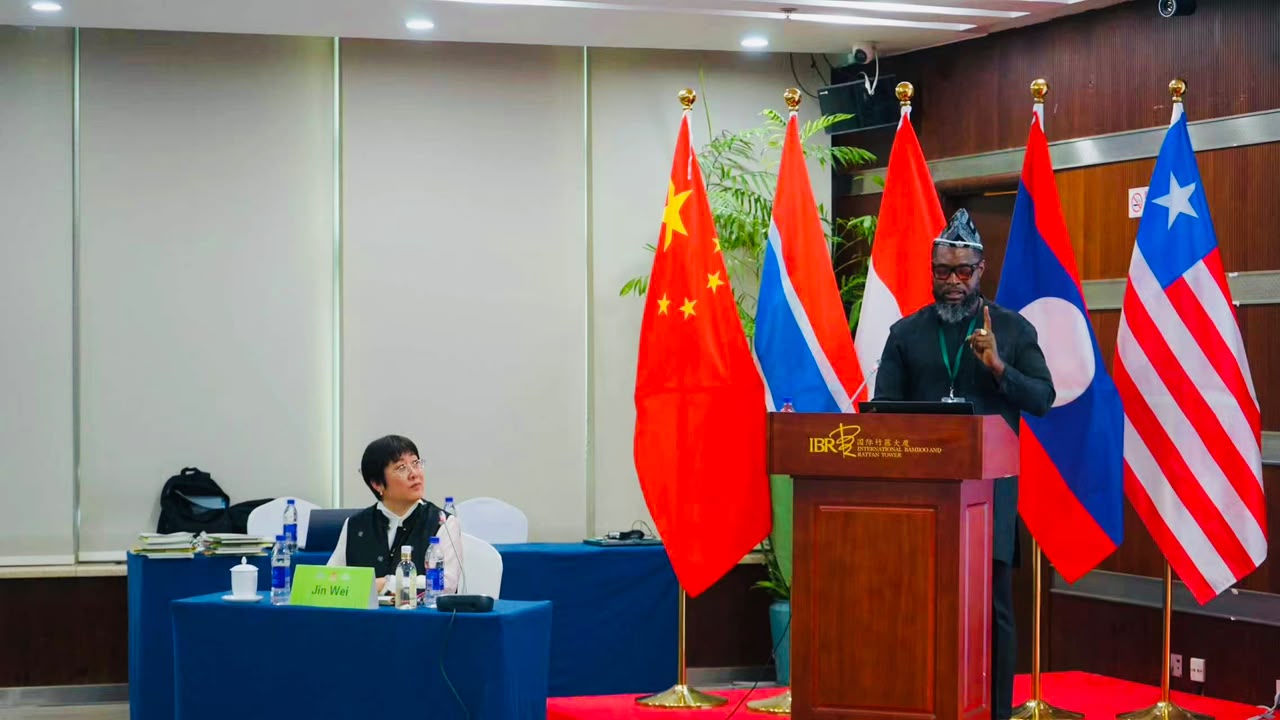
BEIJING – Liberia has articulated a comprehensive vision for sustainable industrialization through bamboo innovation at an ongoing international seminar in China, with a senior delegation official presenting a roadmap to transform the sector into a cornerstone of the nation’s green economy.
Varmah Bobby Gray, Chief of Office Staff in the Office of Senator Nathaniel F. McGill—who chairs the Liberian Senate Committee on Education and Public Administration—led the country’s delegation and delivered the official presentation before senior Chinese government officials, international experts, and delegates from eight participating nations.
Delivering remarks under the theme “From China’s Experience to Liberia’s Transformation: Building a Green Economy Through Bamboo Innovation,” Mr. Gray outlined a national framework designed to operationalize the “Bamboo as a Substitute for Plastic” Initiative. He cited China’s development trajectory—characterized by strategic policy coherence, human capital investment, scientific advancement, and infrastructure modernization—as a replicable model for emerging economies pursuing resilient, low-carbon growth.
The proposed Liberian framework includes the formulation of a National Bamboo Development Strategy, enhanced public-private collaboration, expanded research and development, entrepreneurial and farmer capacity-building, and the cultivation of both domestic and export markets. Mr. Gray identified construction materials, furniture manufacturing, eco-friendly packaging, paper products, handicrafts, and renewable bioenergy as priority sectors poised to generate employment while mitigating plastic waste.
Emphasizing the critical role of international cooperation, Mr. Gray called for deepened bilateral engagement with China through technology transfer, technical training, joint research initiatives, investment partnerships, demonstration projects, and institutional exchanges. He noted that such collaboration would accelerate Liberia’s green transition and reinforce progress toward the United Nations Sustainable Development Goals (SDGs).
“China’s experience shows that sustainable development is driven by innovation, long-term planning, and strategic partnerships,” Mr. Gray stated. “For Liberia, the Bamboo Initiative is not merely an environmental intervention—it is a transformative opportunity to diversify our economy, create green jobs, empower rural communities, and build a more resilient and sustainable future.”
The presentation drew positive recognition for its pragmatic recommendations and emphasis on adapting global best practices to Liberia’s national development priorities. The seminar, which convenes policymakers, researchers, and industry leaders from multiple countries, aims to foster knowledge exchange and innovative solutions for reducing plastic pollution through sustainable bamboo and rattan industries.
Liberia’s active participation underscores its growing commitment to environmental stewardship, green industrialization, and international partnership, while positioning the country for new avenues in investment, technology transfer, and bilateral cooperation with China and the broader global community.

